

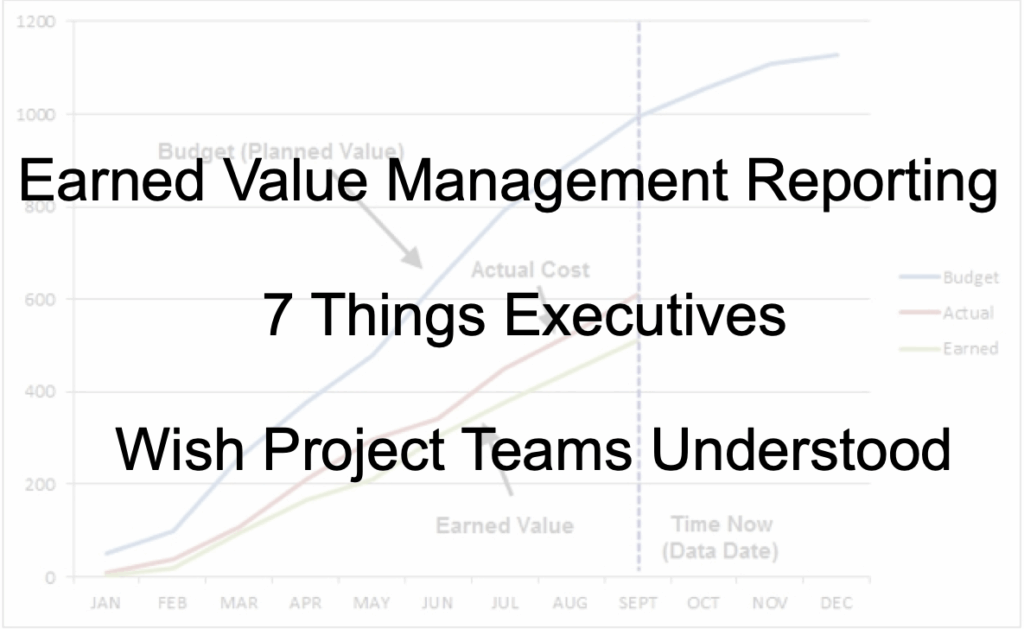
Is it Earned Value Management reporting time where you are? Sometimes it feels like every week is an earned value reporting time. You might think earned value management reporting is about spreadsheets and schedules and endless reports and dashboards, but your executives see it differently.
Many teams focus on metrics, reports, and compliance as the focus and rationale behind what earned value delivers. But they miss what senior leaders actually need from EVM: insight, trust and predictability. Here are seven things executives wish you knew about how they experience and interpret earned value.
1. They don’t care about acronyms
Outcomes is where it’s at. They want to know are we on track, and what are the risks?
If you’re talking about CPI, SPI, or TCPI without context, it’s just noise. Translate those metrics into business impact. That’s easy to do when you understand the metrics yourself. Say something like, “We’re 10% behind on delivery, but recovery is underway.” And list what you are doing to manage the problem.
Why it matters to execs: Decision-making depends on clarity, not jargon.
2. They expect the baseline to mean something
We’re sure this has never happened to you (and we’re certainly not confessing if it’s happened to us) but if you’re constantly re-baselining, senior managers lose confidence in the plan.
Executives want the baseline to reflect what’s actually being delivered. When it changes too often, they get the impression that you don’t know what you are doing. If you are working with high levels of uncertainty and the risk that your timelines will change, bump up the amount of risk-based contingency included in your dates so you can absorb some of the flex that you know is going to come later.
Why it matters: The baseline is used to forecast outcomes and set expectations with stakeholders.
3. They want early warnings, not end-of-month surprises
EVM should help detect issues early, not just report them late. It’s a tool that is just as useful for predicting future performance as it is for identifying how behind you already are.
If your regular reporting and check ins with the team are flagging there is a problem, report that upwards. It’s not OK to wait until the end of the month or whenever your next reporting cycle is to flag significant issues. Use EVM indicators to forecast risk and share signals proactively, even if you need to caveat them by saying you’re gathering more information and will go back with an update later.
Why it matters: Executives are measured on results and hate being blindsided. It’s even worse if someone in the room knows about the problem and your senior sponsor doesn’t. Don’t ever put your leaders on the back foot by withholding information they should know.
4. They expect you to own your variances
“We’re behind because the supplier was late” won’t cut it without a recovery plan. You’re the project leader, and while executives want to know what’s going on, and will stand behind you if there is a genuine problem, they want to see accountability. Blaming someone else for your project’s poor performance isn’t a good look.
Expect your senior leaders to want to know what happened, why, what was done about it, and what support (if any) is needed from them. Spell that last bit out or put it at the top, as some execs will jump straight to solution mode!
Why it matters: Ownership builds trust, and that’s something you can never have too much of.
5. They don’t want to micromanage your CAMs
Control Account Managers should be confident explaining their scope, value earned, and variance drivers. If execs feel they have to interrogate those individuals to get the details, it suggests weak internal controls, and CAMs that don’t really know what is going on.
Why it matters: Strong delivery teams (that execs have confidence in) reduce the oversight burden and increase autonomy. Which is good for everyone!
6. They see EVM as a performance culture tool
To executives, EVM isn’t just tracking, it’s part of your culture. Accurate forecasting, honest reporting, and responsive controls show maturity. Building project management maturity leads to better project outcomes for you and your (internal or external) clients.
If your EVM data is clean and good quality but not used to guide decisions, it’s not being used effectively. And that means it’s a waste of time to gather, track and present those results. EVM should be a proactive part of the way projects are led, not statistics that are simply glanced at and ignored.
Why it matters: Performance-driven teams use data to lead, not just report.
7. They want insight, not just reports
If you’re creating lovely dashboards but no one is reading them, then you are not alone! This is a problem we see often, but the reality is that executives don’t have time to proactively self-serve with dashboards. They need the “so what,” often 10 minutes before their next meeting.
You can help by summarizing what the data says, what it means, and what they should do in clear terms, on a regular pattern so they know when to expect your updates.
Why it matters: Execs rely on your Earned Value Management reporting to act with confidence. If they want more detail they will ask for it, so don’t worry about that!
In a project-based environment where earned value management techniques are embedded and used, we find that executives value the process. Not for the numbers themselves, but for the control and foresight they enable, and the data that allows them to make better decisions and to support the project teams.
You can help that culture of accountability and support because when project teams translate metrics into meaning, they become trusted partners. So have a think: What do your execs really need from your next EVM update?